
“Can your tool become a standard component of teachers’ competence assessments?”
The question came at the end of a focus group with Don Bosco, one of Italy’s leading VET providers — and not a VETCompass partner, which is precisely why we value the pilots and the focus group they kindly agreed to host for us.
As we move towards the delivery of our project on 31 August, a tool that has raised practical interest in systematic implementation is the best reward for a long effort. The Don Bosco participants — teachers, counsellors and school administrators — gave top ratings to the situational approach they were asked to work through, and were more critical of the remaining glitches in the platform. That is the right way round for a pilot: what we designed held, and what remains is engineering. Everyone completed all ten game-based assessments, and the attention paid to smoothness of use confirms that practicality matters as much as design.
But the Don Bosco feedback matters to us for a more general reason. It suggests that a tool of this kind fills a gap that practitioners themselves recognise.
Let’s step back, so as to look forward
It began with the Council Recommendation of 22 May 2018 on key competences for lifelong learning, which placed digital competence and the personal, social and learning-to-learn competence on equal footing. Both were elaborated by the Joint Research Centre into reference frameworks — DigComp and LifeComp. Their implementation then diverged.
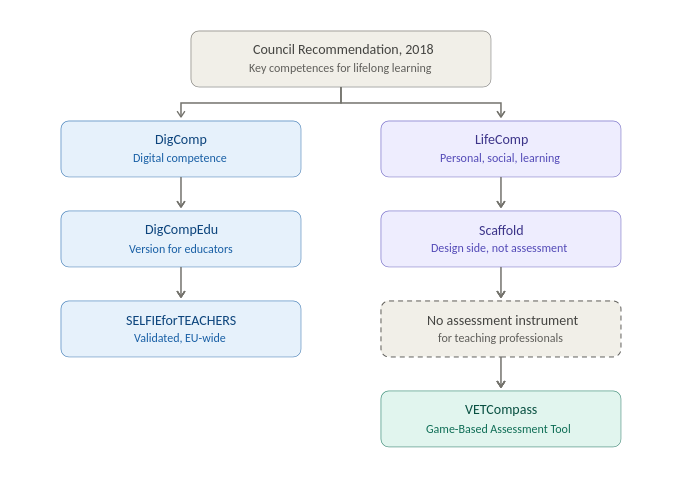
From one Recommendation, two trajectories. The digital branch reached a validated European instrument; the transversal branch reached teaching practice but not assessment.
The digital framework acquired a profession-specific version for educators, DigCompEdu, and on that basis an assessment instrument: SELFIEforTEACHERS, developed by the Joint Research Centre for the European Commission, validated with more than three thousand teachers and now available across Europe in twenty-nine languages. The transversal framework has been carried into teaching practice on the design side — notably through Scaffold, the ETF and JRC card deck that helps teachers build key competences into their learning activities — but not into assessment. There is still no European instrument through which teaching professionals can examine their own transversal competences, and the space is occupied by a scatter of project-generated prototypes.
The reason is not simply that no one funded one. The SELFIE design cannot be transposed: LifeComp deliberately sets no proficiency levels, and its competences are dispositions exercised together rather than behaviours reported separately. A different method was needed — and one already exists in the research literature, in the situational judgment tests developed by Aldrup and colleagues for teachers’ social and emotional competence, though it had never been connected to the European frameworks or to vocational education.
The VETCompass Game-Based Assessment Tool makes that connection, across ten competence themes for VET teaching professionals. It adopts the situational method but declines its usual scoring: it returns a profile of orientation and a library of development resources rather than a result. Competences that are themselves about including and developing others should not, we argue, be graded. Evidence from 175 participants across several national systems suggests the domain can be assessed in this way.
It is a contribution towards filling the gap, not its closure. The question from Don Bosco is what tells us the gap was worth addressing.
References
- Council of the European Union (2018). Recommendation of 22 May 2018 on key competences for lifelong learning (2018/C 189/01). OJ C 189, 4.6.2018.
- Joint Research Centre / European Commission. SELFIEforTEACHERS. https://education.ec.europa.eu/selfie-for-teachers
- European Training Foundation and Joint Research Centre. Scaffold: a card game to revolutionise teaching. https://www.etf.europa.eu/en/what-we-do/scaffold-card-game-revolutionise-teaching
- Aldrup, K., Carstensen, B., Köller, M. M., Klusmann, U. (2020). Measuring teachers’ social-emotional competence: Development and validation of a situational judgment test. Frontiers in Psychology, 11, 892.
- VETCompass (2026). The VETCompass Game-Based Assessment Tool: a contribution to filling a gap. [Link to the full paper.]