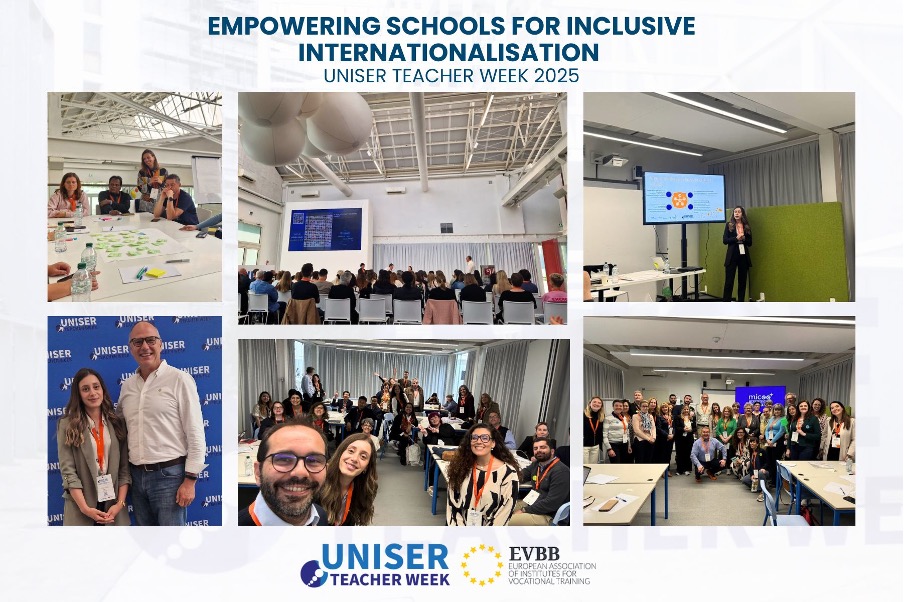
From 7–9 May 2025, the VETCompass project was presented during Uniser Teacher Week 2025 in Bologna, Italy, a three-day training event dedicated to empowering schools for inclusive internationalisation. The event was organised by Uniser Soc. Coop. and hosted at the Fondazione Golinelli, bringing together more than 100 VET professionals from across Europe and beyond.
Teacher Week provided a dynamic platform for peer learning, collaboration, and project co-design, allowing participants to exchange experiences, explore innovative practices, and develop new Erasmus+ project ideas. Throughout the event, educators, training providers, and VET experts engaged in workshops, networking activities, and discussions aimed at strengthening international cooperation in vocational education.
Representing the European Association of Institutes for Vocational Training (EVBB), Sotiria Tsalamani, EU Project & Policy Manager, contributed to the programme by co-facilitating the interactive session “CoVEs: Build your Pathway to Vocational Excellence.” The session was organised together with Paolo Nardi (EfVET) and Patricia Tejada Fernández (EVTA) and introduced participants to the Centres of Vocational Excellence (CoVE) model.
During the workshop, participants worked hands-on with the CoVE Business Model Canvas, exploring how they could design and develop their own initiatives for vocational excellence within their institutions and regional ecosystems.
Within this context, the VETCompass project was also presented as a practical example of how European cooperation projects can support the professional development of VET educators. VETCompass focuses on strengthening the transversal skills of VET teachers, trainers, and staff, through the development of innovative tools such as a Transversal Skills Assessment Framework, a game-based assessment tool, and a toolbox of resources supporting continuous professional development.
The wider programme of Uniser Teacher Week included sessions on inclusive international coordination, mobility strategies, and the growing role of microcredentials in Erasmus+ projects. Through keynote talks, peer learning labs, and collaborative project design workshops, participants explored new ways to enhance the quality, inclusiveness, and impact of vocational education.
The event offered an inspiring opportunity to share practices, build partnerships, and discuss the future of international cooperation in VET. Initiatives like VETCompass demonstrate how collaborative European projects can contribute to strengthening educators’ competences and supporting innovation across VET systems.
EVBB would like to thank Uniser for organising such a valuable event and all participants for their engagement and contributions. Together, we continue to promote excellence, collaboration, and international cooperation in vocational education and training.